Showing posts with label Seville. Show all posts

Sunday, 29 March 2009

Forget the honours and status of life!


Finis Gloriae Mundi, like Valdes Leal's In Ictu Oculi, shows the uselessness of earthly glory and is based on the oriental legend of "The Three Living and the Three Dead". One of the three dead said to one of the three living "what you are, we were, what we are, you will become".

In this painting Valdes Leal has depicted the three dead. The dank, fetid atmosphere of the tomb is created by the diminishing half light and the sombre colours. The dead bishop is still decked in his costume while his flesh crawls with bugs. Worms devour the rotting flesh of the dead knight and the remains of a king are just visible in the obscurity of the crypt. We can almost hear "the gnawing of termites and worms" in the echoing silence around the bodies. A passage from Miguel Manara's Discurso de la Verdad is particularly applicable to this painting:

"If you remember that you will be covered with earth and stepped on by all, you will easily forget the honours and status of this life. Remember also the vile worms that will eat your body and how ugly and abominable you will be in the grave, and how those eyes that will be reading these words will be eaten by the earth, and how those hands will be devoured and left dry, and how the silks and finery that you have today will be converted into a rotten shroud, your amber into a stench, your beauty and grace into worms, your family and greatness into the greatest loneliness imaginable"

It is uncanny that when Manara's tomb was opened seven months after his death in 1679, his body was discovered in perfect condition, entirely uncorrupted.

A stigmatised hand holds the scales for the judgement of the soul. Animals representing the seven deadly sins fill one pan, while it is balanced by prayer books and penitentials in the other. This illustrates the notion that prayer and repentance off set sin. There are two mottoes inscribed on each balance. Nothing more (ni mas) than sin is needed for damnation; nothing less (ni menos) is needed for salvation than prayer and penance. The pan with the prayer books, scourge and hair shirt contains the bare minimum to balance the seven deadly sins, while something more is needed to tip the scales in favour of salvation. Although modern viewers might think the following from I John would inspire the contents of the opposite pan:

"Jesus Christ, the Righteous One. He is the atoning sacrifice for our sins" it is here Charity that sets the scales in favour of Salvation.

A spectacle of Death in Seville!


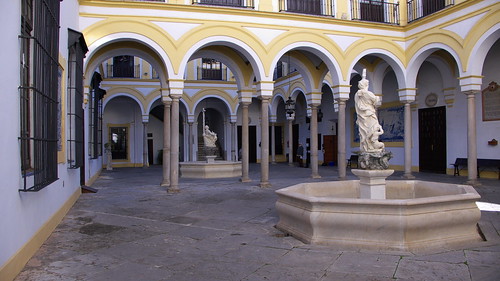
If you were to enter the Church of San Jorge, Hermandad de la Caridad in Seville, the spectacle of death would be all around you. Valdes Leal's In Ictu Oculi and Finis Gloriae Mundi emerge from the dimness, with Pedro Roldan's and Murillo's sculpture of the Entombment of Christ directly ahead, on the high altar, surrounded by Bernardo Simon de Pineda's retablo covering the apse wall. It's crowned by the three cardinal virtues: Faith, Hope and Charity, which are echoed throughout the church's decorative scheme. The altar is the culmination of Murillo's Six Acts of Mercy, as well as showing the founding charity of the Caridad: burial of the dead. This sculpture also shows the promised reward of resurrection and salvation. The worshipper passes from life outside the church, through death (in Valdes Leal's pictures) and on to the blessed life beyond (seen in the high altar). Murillo's six paintings of charitable acts, as well as showing the Brotherhood's primary concerns, are the suggested means of obtaining the final goal of salvation. His St John of God and St Elizabeth of Hungary bring these depicted acts of charity down to earth.

But why this concern with death and charity throughout the church?
In late fifteenth century Spain, men hung by gallows were required by law to remaining hanging for a week after death. Their corpses inevitably fell to the ground during this time, where scavenging animals came to eat them. Legend has it that to allay this horrible custom, Pedro Martinez, an honorary canon of Seville Cathedral, built a wall around the gallows and consecrated the ground within as a cemetery. After the deceased had hung for a week, he carried out a proper funeral and burial.
When Martinez himself died, he bequeathed his money for the upkeep of this practice. It wasn't, however, until at least 1565 that the money was received. By then, a hundred and twenty men had joined together as The Caridad, with the mutual intent of burying the dead. This answered an urgent social need, for it was common in Spain in those days to see the dead victims of starvation, exposure and assault lying around, unburied. The Caridad flourished for over twenty years, and in 1578 the Brotherhood rented the Church of San Jorge from Philip II.
A decade later it was declining, and this low period lasted for about sixty years. The church, always prone to flood damage, fell into bad disrepair, and between 1613 and 1640 there were only twenty nine new members - an average of about one new member a year. But, this decline did not bring the good work to an end.
A series of natural disasters resulted in the revival of the Caridad, which was suddenly faced with having to cope with a heightened rate of mortality. In 1649 a plague reached Seville, having ravaged its way from the east coast leaving ghost towns in its path. A subsequent lack of farm workers to tend crops led to a famine in 1651 caused the death by starvation to hundreds. During the painful years between 1650 - 1653, a hundred and eighteen new members joined the Brotherhood which thus became stronger and more active.
The Caridad grew both in size and importance and in 1661 a new Regla for the charity was drawn up. The following year Mighuel Manara, the man behind the decoration of the church, joined the brotherhood. In 1663 he became leader, and his rule endured until his death sixteen years later in 1679. With the installation of Manara as the leader of the Brotherhood, four new charities became affiliated to the existing charitable burials. The aim of these new tasks was to reduce the number of burials. They set up a hospice in a warehouse rented from the Royal Arsenal, to shelter and feed the homeless and hungry. An ambulance service and the visitation of the sick were instituted, and an infirmary was established to care for the aged and terminally ill. Finally, Manara planned to educate the patients in the Christian faith, an aim which is well reflected in the church's decorative scheme. It was this church which was Manara'a priority and, after a few complications, its renovation was complete by July 1670.